KAVAN PRO 1915–4355 brushless motors - Instruction manual

KAVAN PRO 1915–4355 brushless motors
Introduction
KAVAN PRO brushless outrunner motors use neodymium magnets and a rotating outer case. Their high torque allows direct drive of an electric-flight propeller without a gearbox. Select the winding, battery, propeller and speed controller together to suit the aircraft and its flying weight.
Technical specifications
The tables cover each motor winding separately. Aircraft weights are selection guidelines, not a guarantee of flight performance. A dash means that no value is specified. Propeller dimensions are diameter × pitch in inches. Peak ratings are short-term limits, not continuous ratings.
1915-3750, 2809-2300, 2809-1620, 2811-1800, 2811-2300, 2813-1500
| Motor | 1915-3750 | 2809-2300 | 2809-1620 | 2811-1800 | 2811-2300 | 2813-1500 |
|---|---|---|---|---|---|---|
| LiPo battery | 2–4S LiPo | 2S LiPo | 2–3S LiPo | 2–3S LiPo | 2–3S LiPo | 2–3S LiPo |
| Speed constant (rpm/V) | 3750 | 2300 | 1620 | 1800 | 2300 | 1500 |
| Peak power (W; 180 s) | 312 | 60 | 54 | 110 (2S) | 110 (2S) | 170 (3S) |
| Internal resistance (mΩ) | 98 | 239 | 387 | 138 | 88 | 96.5 |
| No-load current at 10 V (A) | 0.6 | 0.4 | 0.28 | 0.5 | 0.75 | 0.7 |
| Peak current (A; 180 s) | 19.8 | 8.5 | 9.0 | 13 | 15 | 15 |
| Recommended ESC (A) | 20–25 | 8–12 | 10–12 | 15–20 | 15–20 | 15–20 |
| Case diameter (mm) | 18.8 | 28 | 28 | 28 | 28 | 28 |
| Case length (mm) | 16.3 | 8.9 | 8.9 | 11.0 | 11.0 | 13.3 |
| Overall length (mm) | 29.8 | 18.4 | 18.4 | 17.3 | 17.3 | 19.3 |
| Shaft / adapter (mm) | M5/2.0 | *5.5/3.0 | *5.5/3.0 | *5.5/4.0 | *5.5/4.0 | *5.5/4.0 |
| Weight (g) | 16.2 | 15.0 | 15.0 | 20 | 20 | 27.6 |
| Magnetic poles | 12 | 14 | 14 | 14 | 14 | 14 |
| Timing (°) | 15–20° | 20–25° | 20–25° | 20–25° | 20–25° | 20–25° |
| Thermal glider weight (g) | — | — | — | 250 | 250 | 300 |
| Trainer weight (g) | — | 220 | 220 | 250 | 250 | 280 |
| Aerobatic aircraft weight (g) | — | 180 | 180 | 200 | 200 | 250 |
| 3D aircraft weight (g) | — | 130 | 130 | 150 | 150 | 200 |
| Recommended propeller | 3S: 3×4" 4S: 3×3–4" | 2S: 6×3–7×3.5" | 2S: 9×5–10×6" 3S: 8×4" | 2S: 8×4"–9×5" 3S: 7×3.5" | 2S: 8×4–8×4.3" | 2S: 9×5"–10×6" 3S: 8×4" |
PRO 2826-1200, PRO 2826-1000, PRO 2830-1100, PRO 2830-900, PRO 2836-1500, PRO 2836-1050
| Motor PRO | 2826-1200 | 2826-1000 | 2830-1100 | 2830-900 | 2836-1500 | 2836-1050 |
|---|---|---|---|---|---|---|
| LiPo battery | 2–4 S LiPo | 2–4S LiPo | 3–4S LiPo | 3–4S LiPo | 3–4S LiPo | 3–4S LiPo |
| Speed constant (rpm/V) | 1200 | 1000 | 1100 | 900 | 1500 | 1050 |
| Peak power (W; 180 s) | 160 (3S) | 200 (3S) | 350 (4S) | 230 (4S) | 700 (4S) | 470 (3S) |
| Internal resistance (mΩ) | 121 | 163 | 75 | 117 | 35 | 64 |
| No-load current at 10 V (A) | 0.66 | 0.55 | 0.85 | 0.7 | 1.7 | 1.0 |
| Peak current (A; 180 s) | 15 | 14 | 25 | 20 | 45 | 30 |
| Recommended ESC (A) | 15–20 | 15–20 | 25–35 | 20–30 | 45–50 | 30–40 |
| Case diameter (mm) | 28.8 | 28.8 | 28.8 | 28.8 | 28.8 | 28.8 |
| Case length (mm) | 24 | 24 | 28 | 28 | 34 | 34 |
| Overall length (mm) | 40.5 | 40.5 | 44.5 | 44.5 | 52 | 52 |
| Shaft / adapter (mm) | 4.0 | 4.0 | 4.0 | 4.0 | 4.0 | 4.0 |
| Weight (g) | 49 | 50 | 60 | 63 | 80 | 83 |
| Magnetic poles | 14 | 14 | 14 | 14 | 14 | 14 |
| Timing (°) | 20–25° | 20–25° | 20–25° | 20–25° | 20–25° | 20–25° |
| Thermal glider weight (g) | 450 | 450 | 800 | 850 | 950 | 950 |
| Trainer weight (g) | 450 | 450 | 700 | 700 | 900 | 900 |
| Aerobatic aircraft weight (g) | 400 | 400 | 600 | 600 | 800 | 800 |
| 3D aircraft weight (g) | 330 | 330 | 400 | 450 | — | 600 |
| Recommended propeller | 2S: 9×6" 3S: 8×6" | 3S: 9×6" 4S: 8×6" | 3S: 9×6"–10×4.7" 4S: 8×6" | 3S: 9×6"–10×4.7" 4S: 9×6" | 3S: 8×6"–9×6" 4S:8×6" | 3S: 9×6"–10×5" 4S:9×6" |
2836-850, 3530-1500, 3530-1200, 3536-1150, 3536-1000, 3536-850
| Motor | 2836-850 | 3530-1500 | 3530-1200 | 3536-1150 | 3536-1000 | 3536-850 |
|---|---|---|---|---|---|---|
| LiPo battery | 3–4S LiPo | 3–4S LiPo | 2–4S LiPo | 3–4S LiPo | 3–4S LiPo | 3–4S LiPo |
| Speed constant (rpm/V) | 850 | 1500 | 1200 | 1150 | 1000 | 850 |
| Peak power (W; 180 s) | 350 (4S) | 650 (4S) | 300 (3S) | 800 (4S) | 700 (4S) | 650 (4S) |
| Internal resistance (mΩ) | 82 | 43 | 46.5 | 26 | 35 | 43 |
| No-load current at 10 V (A) | 0.9 | 1.2 | 1.24 | 1.8 | 1.5 | 1.2 |
| Peak current (A; 180 s) | 18 | 45 | 25 | 55 | 50 | 45 |
| Recommended ESC (A) | 25–35 | 45–50 | 30–35 | 50–70 | 50–60 | 45–60 |
| Case diameter (mm) | 28.8 | 35.2 | 35.2 | 35.2 | 35.2 | 35.2 |
| Case length (mm) | 34 | 28 | 28 | 34 | 34 | 34 |
| Overall length (mm) | 52 | 48.5 | 48.5 | 54.5 | 54.5 | 54.5 |
| Shaft / adapter (mm) | 4.0 | 5.0 | 5.0 | 5.0 | 5.0 | 5.0 |
| Weight (g) | 79 | 81 | 80 | 108 | 107 | 108 |
| Magnetic poles | 14 | 14 | 14 | 14 | 14 | 14 |
| Timing (°) | 20–25° | 20–25° | 20–25° | 20–25° | 20–25° | 20–25° |
| Thermal glider weight (g) | 1050 | 950 | 1200 | 1600 | 1700 | 1800 |
| Trainer weight (g) | 900 | 900 | 1000 | 1500 | 1600 | 1700 |
| Aerobatic aircraft weight (g) | 800 | 800 | 850 | 1300 | 1330 | 1300 |
| 3D aircraft weight (g) | 600 | 700 | 750 | 1050 | 1050 | 1050 |
| Recommended propeller | 3S: 12×6"–13×8" 4S:10×4.7"–11×5.5" | 3S: 9×6" 4S:8×4–5" | 3S: 10×5" 4S:8×4–5" | 3S: 10×5.5"–11×5.5" 4S:9×5–6" | 3S: 12×6" 4S:10×5" | 3S: 12×6"–13×6.5" 4S: 10×5.5"–11×5.5" |
3542-1150, 3542-950, 3542-830, 3548-900, 3548-750, 3548-500
| Motor | 3542-1150 | 3542-950 | 3542-830 | 3548-900 | 3548-750 | 3548-500 |
|---|---|---|---|---|---|---|
| LiPo battery | 3–4S LiPo | 3–4S LiPo | 3–4S LiPo | 3–4S LiPo | 3–5S LiPo | 6S LiPo |
| Speed constant (rpm/V) | 1150 | 950 | 830 | 900 | 750 | 500 |
| Peak power (W; 180 s) | 1000 (4S) | 900 (4S) | 700 (4S) | 820 (4S) | 870 (5S) | 578 (6S) |
| Internal resistance (mΩ) | 16 | 28 | 39 | 24 | 32 | 67.5 |
| No-load current at 10 V (A) | 2.7 | 2.0 | 1.6 | 2.2 | 1.8 | 1.25 |
| Peak current (A; 180 s) | 70 | 65 | 45 | 57 | 50 | 26 |
| Recommended ESC (A) | 70–80 | 70–80 | 50–60 | 60–70 | 50–60 | 40–50 |
| Case diameter (mm) | 35.2 | 35.2 | 35.2 | 35.2 | 35.2 | 35 |
| Case length (mm) | 41 | 41 | 41 | 47 | 47 | 47 |
| Overall length (mm) | 63.5 | 63.5 | 63.5 | 69.5 | 69.5 | 69.5 |
| Shaft / adapter (mm) | 5.0 | 5.0 | 5.0 | 5.0 | 5.0 | 5.0 |
| Weight (g) | 141 | 139 | 139 | 175 | 175 | 173 |
| Magnetic poles | 14 | 14 | 14 | 14 | 14 | 14 |
| Timing (°) | 20–25° | 20–25° | 20–25° | 20–25° | 20–25° | 20–25° |
| Thermal glider weight (g) | 2200 | 2400 | 2400 | 2600 | 2700 | 2800 |
| Trainer weight (g) | 2100 | 2300 | 2200 | 2500 | 2600 | 2700 |
| Aerobatic aircraft weight (g) | 1800 | 2000 | 1900 | 2300 | 2300 | 2300 |
| 3D aircraft weight (g) | 1200 | 1500 | 1400 | 1400 | 1500 | 1500 |
| Recommended propeller | 3S: 11×8"–12×6" 4S:9×6"–10×5.5" | 3S: 12×6"–13×6.5" 4S:11×5.5"–11×8" | 3S: 13×6.5" –14×7" 4S:11×7"–12×6" | 3S: 14×7"–15×8" 4S:12×6"–13×6.5" | 4S: 13×6.5" 5S:12×6" | 6S:12×6"–13×6.5" |
4345-880, 4345-730, 4355-700, 4355-570
| Motor | 4345-880 | 4345-730 | 4355-700 | 4355-570 |
|---|---|---|---|---|
| LiPo battery | 3–4S LiPo | 4–5S LiPo | 4S LiPo | 4–6S LiPo |
| Speed constant (rpm/V) | 880 | 730 | 700 | 570 |
| Peak power (W; 180 s) | 1100 (4S) | 1300 (5S) | 2013 | 1440 (6S) |
| Internal resistance (mΩ) | 14 | 20 | 13.5 | 18 |
| No-load current at 10 V (A) | 2.0 | 1.6 | 2.45 | 1.9 |
| Peak current (A; 180 s) | 70 | 70 | 117 | 65 |
| Recommended ESC (A) | 70–90 | 70–90 | 120–160 | 70–90 |
| Case diameter (mm) | 43 | 43 | 43 | 43 |
| Case length (mm) | 43 | 43 | 53 | 53 |
| Overall length (mm) | 65 | 65 | 75 | 75 |
| Shaft / adapter (mm) | 5.0 | 5.0 | 5.0 | 5.0 |
| Weight (g) | 221 | 219 | 302 | 298 |
| Magnetic poles | 14 | 14 | 14 | 14 |
| Timing (°) | 20–25° | 20–25° | 20–25° | 20–25° |
| Thermal glider weight (g) | 3000 | 3000 | 3300 | 3500 |
| Trainer weight (g) | 3000 | 3000 | 3300 | 3400 |
| Aerobatic aircraft weight (g) | 2500 | 2500 | 2800 | 2800 |
| 3D aircraft weight (g) | 1800 | 1800 | 2200 | 2200 |
| Recommended propeller | 4S:13×6.5"–14×7" | 4S: 14×8"–15×8" 5S:13×8"–14×7" | 4S: 13×7"–14×7" | 6S:13×8"–14×7" |
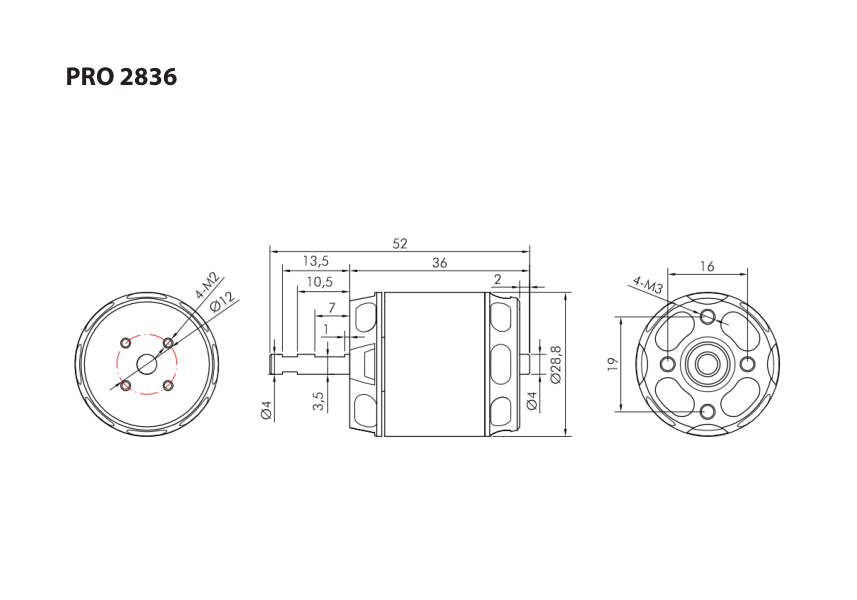
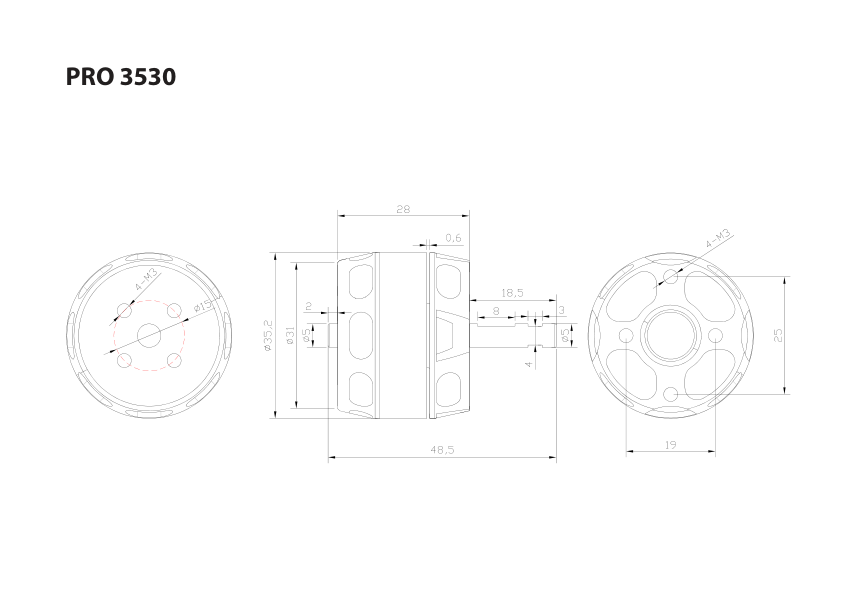
The shaft entry distinguishes the propeller attachment from the motor shaft where two values are shown. For PRO 2809–2813, *5.5 denotes the prop-saver mounting boss; the second value is the motor shaft diameter. Use the dimension drawing to identify the mounting arrangement.
Catalogue variants
| Motor | Product code |
|---|---|
| 1915-3750 | KAV30.2001 |
| 2809-2300 | KAV30.2004 |
| 2809-1620 | KAV30.2005 |
| 2811-1800 | KAV30.2006 |
| 2811-2300 | KAV30.2007 |
| 2813-1500 | KAV30.2008 |
| PRO 2826-1200 | KAV30.2010 |
| PRO 2826-1000 | KAV30.2009 |
| PRO 2830-1100 | KAV30.2011 |
| PRO 2830-900 | KAV30.2012 |
| PRO 2836-1500 | KAV30.2014 |
| PRO 2836-1050 | KAV30.2013 |
| 2836-850 | KAV30.2015 |
| 3530-1500 | KAV30.2017 |
| 3530-1200 | KAV30.2016 |
| 3536-1150 | KAV30.2019 |
| 3536-1000 | KAV30.2018 |
| 3536-850 | KAV30.2020 |
| 3542-1150 | KAV30.2021 |
| 3542-950 | KAV30.2023 |
| 3542-830 | KAV30.2022 |
| 3548-900 | KAV30.2026 |
| 3548-750 | KAV30.2025 |
| 3548-500 | KAV30.2024 |
| 4345-880 | KAV30.2028 |
| 4345-730 | KAV30.2027 |
| 4355-700 | KAV30.2030 |
| 4355-570 | KAV30.2029 |
Required equipment
- A compatible brushless ESC rated for the battery voltage, measured current and motor pole count.
- A suitable LiPo drive battery and balance charger.
- A balanced electric-flight propeller, the correct adapter and a rigid motor mount.
- A radio system, insulated connectors, suitable fasteners and a current/power meter.
Safety notes
Disconnect the drive battery before working on the motor or propeller. Remove the propeller for radio setup and ESC calibration. The outer motor case rotates: keep wires, batteries, tools, clothing and the aircraft structure clear of it.
- Keep spectators, especially children, at least 6 m away during preparation and motor operation. Point the propeller away from people and keep everyone outside its plane of rotation.
- Use only undamaged, balanced propellers. Inspect the propeller after every flight. Replace it after a strike, crash or heavy landing even if no damage is visible; also replace any propeller with cracks, nicks, scratches or stress whitening.
- Use the motor only for its intended model-aircraft application and keep it away from corrosive environments.
- A spinner used with a fixed propeller must not touch the blades.
- Tighten the propeller attachment securely with the appropriate tool. Never touch a rotating propeller or stop it with an object.
- Leave the propeller free to turn even with the throttle closed. Unexpected starting or a stalled motor can damage the ESC and motor or cause a fire.
- Switch on the transmitter first, check the throttle and motor-stop controls, then connect the drive battery. Disconnect the drive battery after use.
Main section
Selecting the motor and power system
- Determine the aircraft's completed flying weight and intended use. Use the thermal-glider column for thermal soaring; use the aerobatic or 3D column for a hotliner or a model requiring a much higher climb rate.
- To replace another outrunner, first compare motor weight and speed constant (KV), then check the actual battery, propeller, current and cooling requirements. Similar weight and KV are selection aids, not proof that two motors have identical limits.
- Choose an ESC that supports the required battery voltage and can carry the current, including acceleration peaks. Check the motor's pole count against the ESC's capabilities.
- Start with the propeller recommendation for the exact winding and cell count. Use a propeller intended for electric flight. A suitable folding propeller can also be used where the aircraft and adapter permit.
A larger diameter or higher-pitch propeller increases load. Measure current and monitor both motor and ESC temperature before approving a different propeller. Do not exceed the motor, ESC, connector or battery limits.
Motor installation
Firewall and clearance
Mount the motor on a rigid, securely bonded firewall. Select its thickness according to the motor size and aircraft structure:
| Motor family | Birch or beech aircraft plywood |
|---|---|
| PRO 19xx | 1.0–1.5 mm |
| PRO 2809–2813 | 1.2–2 mm |
| PRO 2826–2836 | 2–3 mm |
| PRO 35xx | 3–5 mm |
| PRO 43xx | 5–6 mm |
Use the thicker end of the range for a larger or longer motor and higher loads. Keep the rotating case completely clear of the airframe and equipment; a separating former can help protect the wiring and battery space.
Front and radial mounting
Use the mounting arrangement shown for your motor. For front mounting, choose screws with enough thread engagement to hold the motor securely without reaching its windings. Screws that are too short can strip the mounting threads; screws that are too long can damage the windings. Fit the supplied radial mount for rear mounting.
The PRO 1915 uses radial mounting. Its propeller attachment has an M5×0.8 left-hand thread; do not force it in the direction used for a normal right-hand thread.
Cooling
Provide airflow through the motor openings and around the outside of its rotating case. As a starting point, make the cooling intake area at least twice the combined area of the motor openings and the outlet area about twice the intake area. Keep both openings unobstructed. Overheating accelerates bearing wear and can demagnetise the magnets, reducing performance.
Dimensions and mounting drawings
Use the drawing for the correct motor family. Check the actual hardware before drilling the firewall; do not measure dimensions from a scaled screen image.




Electrical connection and direction check
- With the battery disconnected and the propeller removed, connect the three motor leads to the ESC. Insulate every joint separately and secure the leads away from the rotating case.
- Connect the receiver and set up the ESC using its own instructions. For KAVAN controllers, see the PRO ESC manual or Plus ESC manual, as applicable.
- Secure the aircraft, switch on the transmitter with throttle at minimum and motor stop active, then connect the drive battery. Briefly run the motor at low speed to check rotation and smooth operation.
- If rotation is incorrect, disconnect the battery and swap any two of the three motor-to-ESC connections. Alternatively, use the direction setting of an ESC that supports it. Repeat the check.
- Disconnect the battery before installing the balanced propeller. No running-in is required.
Ground test and operation
- Check the mount, propeller attachment, cooling openings, wiring, battery restraint and aircraft centre of gravity.
- Secure the aircraft and clear the propeller area. Switch on the transmitter, check minimum throttle and the motor-stop function, then connect the battery.
- Increase power progressively while measuring current. Stop immediately if the motor stutters, vibrates, rubs or becomes excessively hot.
- Confirm that full-power load stays within every component's rating and within the applicable short-term motor limits. Improve cooling or reduce propeller load if necessary.
- Check receiver failsafe and range according to the radio instructions. Perform signal-loss tests with the propeller removed.
- After landing, stop the motor and disconnect the drive battery before switching off the transmitter or handling the propeller. Allow the motor and ESC to cool before the next flight.
Care and maintenance
- Keep the motor dry and protect it from dust. Keep screws, swarf and other magnetic debris away from its openings.
- Do not dismantle the motor. The bearings are grease-lubricated for their service life and do not require additional lubrication.
- Do not use organic solvents, cleaners or detergents: they can remove the bearing grease.
- If dirt enters the motor after a crash, do not turn the shaft. Carefully remove loose contamination with compressed air first. Send a motor with substantial contamination or damage for service.
- Never straighten a bent shaft. Straightening can leave hidden cracks; subsequent shaft failure or vibration can break the propeller or tear out the firewall. Stop using a motor with a bent shaft, damaged bearings, rubbing rotor or unusual vibration and arrange inspection through your retailer or KAVAN service.
Appendix
Guarantee
The KAVAN Europe s.r.o. products are covered by a guarantee that fulfils the currently valid legal requirements in your country. If you wish to make a claim under guarantee, please contact the retailer from whom you first purchased the equipment. The guarantee does not cover faults which were caused in the following ways: crashes, improper use, incorrect connection, reversed polarity, maintenance work carried out late, incorrectly or not at all, or by unauthorised personnel, use of other than genuine KAVAN Europe s.r.o. accessories, modifications or repairs which were not carried out by KAVAN Europe s.r.o. or an authorised KAVAN Europe s.r.o., accidental or deliberate damage, defects caused by normal wear and tear, operation outside the Specification, or in conjunction with equipment made by other manufacturers. Please be sure to read the appropriate information sheets in the product documentation.
For service, contact the retailer from whom you purchased the product. Use the original packaging if available. Include a dated description of how the product was used and the fault, together with your full address and telephone number.
Incorrect installation, inadequate mounting or cooling, cable strain, reversed polarity and operation beyond the specified limits are not covered. Protect the device from excessive heat, moisture and dust, and do not leave it in direct sunlight for prolonged periods.
Recycling (European Union)
Electrical equipment bearing the crossed-out bin symbol must not be disposed of in normal household waste. Instead, it must be taken to a specialised collection and recycling facility. In EU (European Union) countries, electrical equipment must not be disposed of in normal household waste (WEEE – Waste of Electrical and Electronic Equipment, Directive 2012/19/EU). You can take unwanted equipment to your nearest collection or recycling centre. The equipment will then be disposed of or recycled safely, free of charge. By handing in your unwanted equipment, you can make an important contribution to protecting the environment.
EU declaration of conformity
Hereby, KAVAN Europe s.r.o. declares that the KAVAN PRO brushless motors are in compliance with the essential requirements of relevant European directives and norms. The full text of the Declaration of Conformity is available at www.kavanrc.com/doc/