KAVAN Standard ESCs - Instruction manual
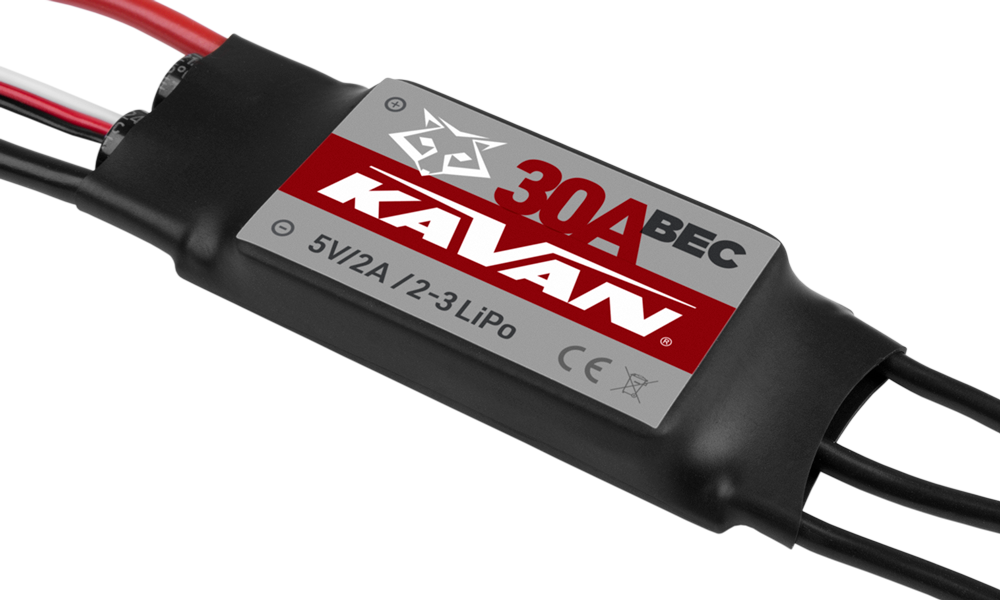
KAVAN R-6B–R-80SB standard ESCs
Introduction
Congratulations on your purchase of a KAVAN line electronic controller for brushless motors. The state-of-the-art KAVAN Line covers almost the entire range of electric powered planes flown by a Sunday flyer. All the ESCs can be quickly programmed using your transmitter and even easier with the optional KAVAN Programming Card.
Programmable functions overview
- Brake Setting (use the brake on for folding props applications only).
- Battery Type (LiPo or NiCd/NiMH).
- Low Voltage Cut-Off Type (power reduction or immediate shutdown).
- Low Voltage Cut-Off Setting.
- Soft Acceleration Start Ups (for gearbox and helicopter applications).
- Timing Settings (to enhance ESC efficiency and smoothness).
Specification
| Model | BEC Type | Current Continuous/Burst | Input Voltage | Weight | BEC Voltage/Current | Dimensions |
|---|---|---|---|---|---|---|
| KAVAN R-6B | *BEC | 6/8 A | 2S LiPo | 5.5 g | 5 V/0.8 A | 32×12×4.5 mm |
| KAVAN R-12B | *BEC | 12/15 A | 2–3S Li-Po | 9 g | 5 V/1 A | 38×18×6 mm |
| KAVAN R-15B | *BEC | 15/20 A | 2–3S Li-Po | 16.5 g | 5 V/2 A | 48×22.5×6 mm |
| KAVAN R-20B | *BEC | 20/25 A | 2–3S Li-Po | 19 g | 5 V/2 A | 42×25×8 mm |
| KAVAN R-30B | *BEC | 30/40 A | 2–3S Li-Po | 37 g | 5 V/2 A | 68×25×8 mm |
| KAVAN R-40B | *BEC | 40/55 A | 2–3S Li-Po | 39 g | 5 V/3 A | 68×25×8 mm |
| KAVAN R-40SB | **SBEC | 40/55 A | 2–4S Li-Po | 43 g | 5 V/3 A | 65×25×12 mm |
| KAVAN R-50SB | **SBEC | 50/65 A | 3–6S Li-Po | 41 g | 5 V/7 A | 65×29×10 mm |
| KAVAN R-60SB | **SBEC | 60/80 A | 3–6S Li-Po | 63 g | 5 V/7 A | 77×35×14 mm |
| KAVAN R-80SB | **SBEC | 80/100 A | 3–6S Li-Po | 82 g | 5 V/7 A | 86×38×12 mm |
*) BEC – linear BEC **) SBEC – powerful switching BEC
Main section
Connecting the KAVAN ESC
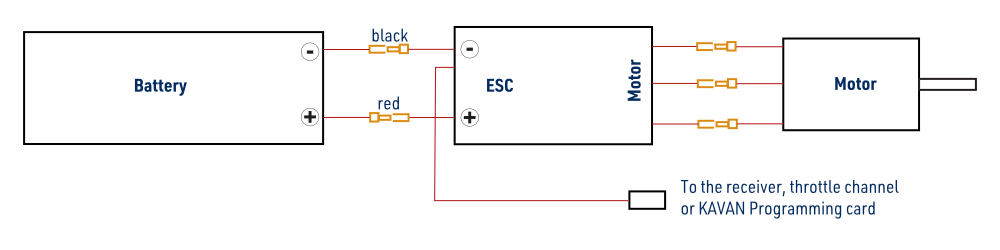
The speed controller can be connected to the motor by soldering directly or with high-quality connectors. Always use new connectors, which should be soldered carefully to the cables and insulated with a heat-shrink tube. Use only high-quality connectors to connect the ESC to the flight pack as well - Ø2 mm gold-plated connectors (KAV36.119 or KAV36.120) for currents up to 20 A; Ø3.5 mm (KAV36.122), Ø4 mm (KAV36.126) gold plated connectors or DEAN-T® KAV36.108 for currents up to 60 A and Ø6 mm (KAV36.128) for currents up to 80 A. The battery-to-ESC wires must not exceed 15 cm (6 inches). Observe the correct polarity: red (+), black (−).
Plug the UNI servo connector cable of the ESC to your receiver throttle output. The ESCs featuring BEC or SBEC voltage stabilizer feed your receiver and servos from the flight battery pack.
Please bear in mind improper polarity or a short-circuit will damage the ESC, therefore it is your responsibility to double-check all plugs for proper polarity and connection BEFORE connecting the battery pack for the first time.
Powering up for the first time & the automatic throttle calibration
The KAVAN ESC features Automatic Throttle Calibration to ensure the smoothest throttle response and resolution throughout the entire throttle range of your transmitter. This step has to be performed just once to allow the ESC to „learn and memorise“ the throttle output signal of your transmitter. It only needs to be repeated if you change your transmitter.
- Switch on the transmitter and move the throttle stick to the top position.
- Connect the battery pack to the ESC, and wait about 2 seconds.
- The „Beep–Beep–“ tone should be emitted, which means the top point of the throttle range has been confirmed.
- Move the throttle stick to the bottom position. Several „beep–“ tones should be emitted to present the amount of battery cells.
- A long „Beep–“ tone should be emitted, which means the lowest point of the throttle range has been correctly confirmed.
The throttle is now calibrated and your ESC is ready for operation.
Normal ESC start-up procedure
- Move the throttle stick to the bottom position and then switch on the transmitter.
- Connect the battery pack to ESC. A special tone like „♪ 123“ means the power supply is OK.
- Several „beep–“ tones should be emitted to present the amount of lithium battery cells.
- When the self-test is finished, a long „beep–“ tone should be emitted.
- Slowly move the throttle stick up. The prop should start rotating clockwise (looking from the cockpit of the plane). If it spins in the opposite direction, pull the throttle stick back, disconnect the flight battery and swap any two of the three cables between the motor and the ESC. Then re-check again.
Protection function
- Startup failure protection: If the motor fails to start within 2 seconds of throttle application, the ESC will cut-off the output power. In this case, the throttle stick MUST be moved to the bottom again to restart the motor. (Such a situation happens in the following cases: the connection between ESC and the motor is not reliable, the propeller or the motor is blocked, the gearbox is damaged, etc.).
- Overheat protection: When the temperature of the ESC is over about 110 °C, the ESC will reduce the output power.
- Throttle signal loss protection: The ESC will reduce the output power if the throttle signal is lost for 1 second. If the signal is absent for more than 2 seconds, the output is cut off completely.
Programmable functions
The highlighted values are the default factory settings.
-
Brake: ON/OFF
- ON: Sets the propeller to the brake position when the throttle stick is at the minimum position (Recommended for folding props).
- OFF: Sets the propeller to freewheel when the throttle stick is at the minimum position.
-
Battery type: LiPo or NiCd/NiMH
-
Low Voltage Cut-off type: Reduce Power/Hard Cut-off
- Reduce Power: ESC reduces motor power when the preset Low Voltage Protection Threshold value is reached.
- Hard Cut-off: ESC instantly cuts motor power off when the preset Low Voltage Protection Threshold value is reached.
-
Low Voltage Protection Threshold: (Low/Medium/High)
- For Li-xx packs: the battery cell number is calculated automatically. The Low/Middle/High cut-off voltage for each cell is 2.85/3.15/3.3 V. For example: For a 3S LiPo, when the „Middle“ cut-off threshold is set, the cut-off voltage will be 3.15×3 = 9.45 V.
- For Ni-xx packs: Low/Middle/High cut-off voltages are 0/50/65 % of the startup voltage (i.e. the initial voltage of the battery pack), and 0 % means the low voltage cut-off function is disabled. For example: For a 6-cell NiMH battery, the fully charged voltage is 1.44×6 = 8.64 V, when the „Middle“ cut-off threshold is set, the cut-off voltage will be: 8.64×50 % = 4.32 V.
-
Soft Acceleration Startup: Normal/Soft/Very Soft (300 ms / 1.5 s / 3 s)
- Normal mode is suitable for fixed-wing aircraft. Soft or Very Soft modes are suitable for helicopters. The initial acceleration of the Soft and Very Soft modes is slower, it takes 1.5 seconds for Soft startup or 3 seconds for Very Soft startup from initial throttle advance to full throttle. If the throttle is completely closed (throttle stick moved to bottom position) and opened again (throttle stick moved to top position) within 3 seconds after the first startup, the re-startup will be temporarily changed to normal mode to get rid of the chance of a crash caused by slow throttle response. This special design is suitable for aerobatic flight when quick throttle response is needed.
-
Timing setup: Low / Middle / High
- Low (3.75°) – Setting for most 2-pole motors.
- Middle (15°) – setting for motors with 6 or more poles.
- High (26.25°) – setting for motors with 12 or more poles, outrunners
- In most cases, middle or low timing works well for all types of motors. However, for high efficiency, we recommend the Low timing setting for 2-pole motors (generally, in-runners) and middle timing for 6 poles and above (generally all outrunners). For higher speeds, High timing can be set. Some motors require different timing setups therefore we suggest you follow the manufacturer-recommended setup.
NoteRun your motor on the ground first after making any changes to your motor timing!
Programming the KAVAN ESC with your transmitter
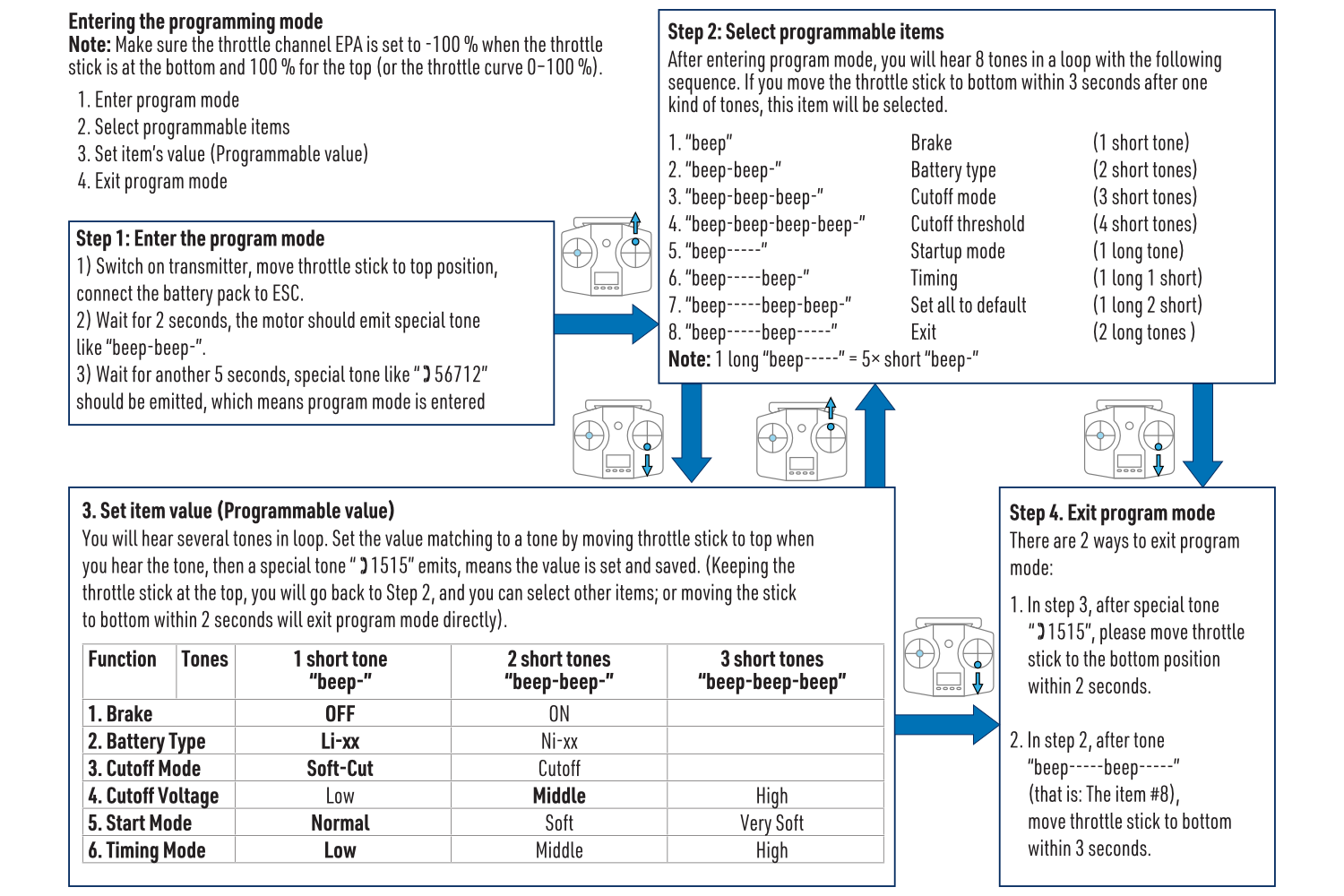
Follow the sequence in (Fig. 2) and the steps below.
Set the throttle channel endpoints to −100 % at minimum and 100 % at maximum, or use a throttle curve spanning 0–100 %.
Enter programming mode
- Switch on the transmitter, move the throttle stick to maximum and connect the battery to the ESC.
- Wait 2 seconds for two short beeps.
- Wait another 5 seconds for the „♪ 56712“ melody confirming programming mode.
Select a function
The eight signals below repeat in a loop. Move the throttle stick to minimum within 3 seconds after the required signal to select that item. One long beep equals five short beeps.
| Signal | Function |
|---|---|
| 1 short beep | Brake |
| 2 short beeps | Battery type |
| 3 short beeps | Cut-off type |
| 4 short beeps | Cut-off voltage |
| 1 long beep | Startup mode |
| 1 long + 1 short beep | Timing |
| 1 long + 2 short beeps | Restore all defaults |
| 2 long beeps | Exit |
Set the value
The available values repeat as beep signals. Move the throttle stick to maximum when the desired signal sounds. The „♪ 1515“ melody confirms that the value has been saved. Keep the stick at maximum to return to function selection, or move it to minimum within 2 seconds to exit programming.
| Function | 1 short beep | 2 short beeps | 3 short beeps |
|---|---|---|---|
| Brake | OFF | ON | — |
| Battery type | Li-xx | Ni-xx | — |
| Cut-off type | Reduce power | Hard cut-off | — |
| Cut-off voltage | Low | Medium | High |
| Startup mode | Normal | Soft | Very soft |
| Timing | Low | Middle | High |
Exit programming mode
Move the throttle stick to minimum within 2 seconds of the „♪ 1515“ confirmation melody, or select the exit item by moving the stick to minimum within 3 seconds after the two-long-beep signal.
Using the KAVAN programming card (optional)
You can also use the optional KAVAN Programming card (KAV32.42015) to program your desired functions. The use of the KAVAN card is very simple and convenient: the programmable functions and their values are set with a couple of buttons. Simply set all the functions on the card to the desired values and load the settings to the ESC. Programming your ESC with the KAVAN Card is a breeze.
Please refer to the KAVAN Programming Card - Instruction manual.
Troubleshooting
| Issue | Possible reason | Solution |
|---|---|---|
| After powering on, the motor does not work and no sound is emitted. | The connection between the battery pack and ESC is not correct. | Check the power connection. Replace the connector. |
| After powering on, the motor does not work, such an alert tone is emitted: „beep–beep–, beep–beep–, beep–beep–“ (Every „beep–beep–“ has a time interval of about 1 second). | Input voltage is abnormal, too high or too low. | Check the voltage of the battery pack. |
| After powering on, the motor does not work, such an alert tone is emitted: „beep–, beep–, beep–“ (Every „beep–“ has a time interval of about 2 seconds). | Throttle signal is irregular. | Check the receiver and transmitter. Check the cable of the throttle channel. |
| After powering on, the motor does not work, such an alert tone is emitted: „beep–, beep–, beep–“ (Every „beep–“ has a time interval of about 0.25 seconds). | The throttle stick is not in the bottom (lowest) position. | Move the throttle stick to the bottom position. |
| After powering on, the motor does not work, a special tone „56712“ is emitted after a 2-beep tone (beep–beep–). | The direction of the throttle channel is reversed, so the ESC has entered the program mode. | Set the direction of the throttle channel correctly. |
| The motor runs in the opposite direction. | The connection between ESC and the motor needs to be changed. | Swap any two wire connections between ESC and motor. |
Appendix
Safety precautions
- Do not install the propeller (fixed wing) or drive pinion (helicopter) on the motor when you test the ESC and motor for the first time to verify the correct settings on your radio. Only install your propeller (plane) or pinion (heli) after you have confirmed that the settings on your radio are correct.
- Never use ruptured or punctured battery cells.
- Never use battery packs that are known to overheat.
- Never short circuit battery or motor terminals.
- Always use proper insulation material for cable insulation.
- Always use reliable, polarised cable connectors.
- Do not exceed the number of cells or servos specified for the ESC.
- Wrong battery polarity will damage the ESC and void the warranty.
- Install the ESC in a suitable location with adequate cooling ventilation. Thermal protection can reduce or interrupt motor power around 110 °C (230 °F).
- Use only batteries supported by the ESC and ensure the correct polarity before connecting.
- Switch your transmitter ON first and ensure the throttle stick is in the minimum position before connecting the battery pack.
- Never switch your transmitter OFF while the battery is connected to your ESC.
- Only connect your battery pack just before flying and do not leave your battery pack connected after flying.
- Once the battery is connected, handle the model as if the motor could start at any time. Keep fingers, your face and loose clothing away from the propeller. Keep yourself and bystanders out of the plane of rotation and never stand directly in front of rotating parts.
- Do not immerse the ESC under water, do not allow it to get wet while powered up.
- Always fly at a designated flying site and follow the rules and guidelines set by your modeller’s club.
Warranty and post-warranty service
All KAVAN ESCs are covered by a 2-year warranty covering all manufacturing defects and faults. When making a claim within the warranty period, please always present a copy of the proof of purchase with the product and provide the service personnel with as detailed and complete information as possible about the defect found, your usage and other information that will facilitate the assessment of the claim and speed up its settlement. Please make your claim at the shop where you purchased the product. If this is not possible, you can directly contact KAVAN Europe s.r.o.:
KAVAN Europe s.r.o. | Doubravice 110, 533 53 Pardubice | Czechia | +420 466 260 133 | info@kavanrc.com
Warranty and limitation of liability
As the manufacturer of this product, we have no control over your compliance with these instructions when wiring and installing the ESC into your model. Likewise, we have no control over the way you build, operate and maintain the RC set parts. For this reason, KAVAN must disclaim all liability for any loss, damage or financial cost that is caused by the improper use or operation of products imported by us, or that is in any way connected with such activity.
Except as otherwise provided by law, KAVAN’s obligation to pay compensation shall (regardless of the legal arguments asserted) be limited to the purchase price for those KAVAN products that were directly involved in the event that caused the damage. This does not apply if the manufacturer has been judicially obliged to make unlimited compensation on the basis of proven wilful or gross negligence. We warrant that our products are in compliance with current legal provisions. The warranty does not cover failures and defects caused by:
- Misuse or improper use.
- Delayed, improper or no maintenance, or maintenance performed by an unauthorised service.
- Incorrect wiring.
- Use of accessories not approved or recommended by KAVAN Europe s.r.o.
- Modifications or repairs not carried out by an authorised KAVAN Europe s.r.o.
- Inadvertent or deliberate damage.
- Normal wear and tear.
- Operation of the equipment outside the operating limits specified in the specification.
KAVAN Europe s.r.o. warrants that this product is free from defects in both material and workmanship at the time of sale. KAVAN Europe s.r.o. also reserves the right to change or modify this warranty without notice. The equipment is subject to continuous improvement and refinement – the manufacturer reserves the right to change the design without notice.
This warranty certificate entitles you to a free warranty repair of the product supplied by KAVAN Europe s.r.o. within a period of 24 months. The warranty does not cover natural wear and tear due to normal use, as this is a product for modelling use, where the individual parts operate under much higher loads than normal toys are subjected to.
The warranty also does not cover any part of the equipment that has been improperly installed, roughly or improperly handled, or damaged in an accident, or any part of the equipment that has been repaired or altered by an unauthorised person (this includes the application of any waterproof sprays/coatings by the user). Like other fine electronics products, do not expose this equipment to high temperatures, low temperatures, moisture, dusty environments, violent mechanical shocks and impacts. Do not leave it in direct sunlight for extended periods of time.
Improper installation includes inadequate mounting, mechanical strain on cables and insufficient cooling.
Please claim warranty repairs from the shop where you purchased the product.
If possible, use the original packaging when returning the product for service. Include a dated description of its use and the fault, together with your full address and telephone number.
Recycling (European Union)
Electrical equipment bearing the crossed-out bin symbol must not be disposed of in normal household waste. Instead, it must be taken to a specialised collection and recycling facility. In EU (European Union) countries, electrical equipment must not be disposed of in normal household waste (WEEE – Waste of Electrical and Electronic Equipment, Directive 2012/19/EU). You can take unwanted equipment to your nearest collection or recycling centre. The equipment will then be disposed of or recycled safely, free of charge. By handing in your unwanted equipment, you can make an important contribution to protecting the environment.
EU Declaration of Conformity
KAVAN Europe s.r.o. hereby declares that the KAVAN standard-line brushless electronic speed controllers comply with the essential requirements of the applicable EU directives concerning electromagnetic compatibility.
The full text of the EU Declaration of Conformity is available at www.kavanrc.com/doc.